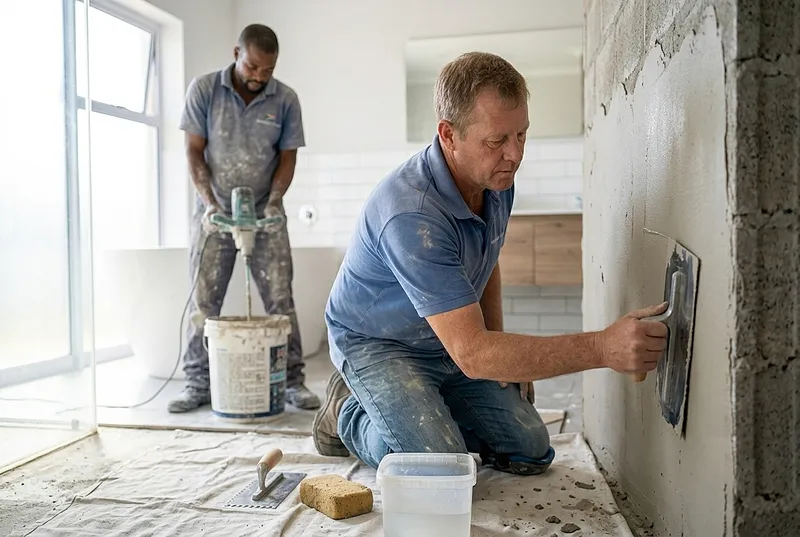
How much does plastering cost in South Africa?
Plastering and drywall work in South Africa covers everything from patching hairline cracks to full new-build plaster and Gyproc partition installations. Here are typical costs for 2025–2026.
Typical plastering costs (2025–2026)
| Job type | Typical price range |
|---|---|
| Crack or hole repair (small, up to 150mm) | R200 – R650 |
| Wall patch repair (up to 0.5m²) | R550 – R1,600 |
| Full room replaster (per m²) | R150 – R250 per m² |
| Skim coat (plaster finishing, per m²) | R85 – R200 per m² |
| Ceiling repair (water damaged, per m²) | R150 – R350 per m² |
| Cornice installation (per linear metre) | R85 – R200 per m |
| Drywall partition (per m²) | R350 – R750 per m² |
| Suspended ceiling (grid + boards, per m²) | R400 – R850 per m² |
| Damp proof injection (per linear metre) | R300 – R750 per m |
| Waterproof skim (damp proofing, per m²) | R150 – R350 per m² |
What affects the price?
- Existing surface condition. Plastering over a structurally unsound or heavily contaminated surface (damp, paint flaking) requires preparation work that adds cost.
- Access and height. High ceilings and difficult access require scaffolding, which is typically charged separately at R1,600–R4,200 per week.
- Finish type. A smooth, paint-ready skim finish takes more time and skill than a rougher sand or float finish. Decorative finishes (Venetian plaster) are significantly more expensive.
- Damp underlying causes. Damp plastering is only effective if the moisture source is addressed first. Roof leaks, rising damp, and plumbing leaks must be repaired before replastering — budget for the underlying repair separately.
- Materials. PPC or AfriSam cement, fibreglass mesh, bonding agents, and damp-proof compounds all affect the final cost.
Damp and rising damp explained
Rising damp is caused by moisture travelling up through the base of walls from ground level due to a failed damp proof course (DPC). It shows as a tide-mark stain typically 300–600mm from floor level, often with salt deposits (efflorescence). Treatment involves injecting a chemical DPC into the wall base (R300–R750 per linear metre) and replastering with a waterproof render. Simply replastering over rising damp without treating the source will fail within 12–24 months.
Tips for getting a fair price
- For damp-related work, ask the plasterer to identify the moisture source — a reputable plasterer will not plaster over an active leak or untreated rising damp.
- Confirm whether preparation work (hacking off old plaster, dust management) is included in the m² rate or charged separately.
- For large jobs, ask to see a similar completed project to assess the quality of their finish.
- Avoid paying the full amount upfront. TruePro's payment protection holds your payment securely until you've confirmed the work meets your expectations.